Your Heart Is a Muscle. Are You Training It?
By Abhishek Maheshwari | Wellness Wisdom
Let me start with something that I think most of us get wrong about the heart.
We think of heart disease as something that happens to us — suddenly, without warning, as if the heart just gave up one day. But that's not how it works. Heart disease builds up over 20, 30 years. Slowly. Quietly. And the good news — the really good news — is that if it builds up slowly, it can also be addressed slowly. Through what we eat, how we move, how we breathe, and how we manage stress.
That's what I want to talk about today.
The Heart Is Unlike Any Other Muscle
Here's the first thing to understand. Your heart is a muscle — but it is unlike any other muscle in your body.
Think about your bicep, your shoulder, your chest muscles. You use them, they get tired, you rest them, they recover. That's how every muscle in the body works. You stress it, you rest it, you grow it.
The heart does not work that way. It keeps working throughout your entire lifetime. It does not take rest. It does not get a day off. The moment it stops, you stop. So this particular muscle — this unique, irreplaceable muscle — operates under a completely different set of demands than anything else in the body.
And precisely because of this, we have to think about heart health differently. We are not just training it. We are also learning to regulate it.
Four Things That Make Up Your Heart Health
When I talk about cardiovascular health, I'm not just talking about the heart organ itself. There are four components that together make up what we mean by "heart health."
First is the organ — the heart muscle itself. Is it strong? Is it trained? Can it pump a good amount of blood in a single beat, or does it have to work overtime, pumping again and again to push out what a well-trained heart would do in one go?
Second are the arteries — the pipes that carry the blood throughout the body. For blood to flow freely, these pipes need to be open, flexible, and free from obstruction. When they get stiff, when they narrow, when there is plaque building up inside them, the blood has less space to flow through. And the heart has to push harder.
Third is the blood itself — the quality of what is flowing through those pipes. Too much fat in the bloodstream, blood that is too thick, blood that is inflamed — all of this puts pressure on both the arteries and the heart.
Fourth is the electrical system — what I sometimes call the spark. This is what controls the rhythm, the frequency, the timing of each heartbeat. When this gets disrupted, you get arrhythmia. The heart beats too fast, too slow, or irregularly — and none of those are good.
Now, all four are connected. If one goes out of balance, the others follow. And yoga — when practiced intelligently — can have a positive impact on all four.
How Stress Quietly Attacks Your Heart
Let me walk you through something that I think most people have never heard explained clearly. This is the actual chain of events through which chronic stress damages your heart.
When you are under chronic stress, two things happen in the body. Your adrenaline levels go up — adrenaline is what keeps you alert, it's what gives you that edge. And your cortisol goes up — that's the stress hormone. Now in small doses, both are useful. The problem is when they are elevated continuously, day after day, because of lifestyle stress, work stress, relationship stress, financial pressure — whatever it is.
When these stress hormones are consistently elevated, they activate something that you would not expect. They activate the fat around your organs — what is called visceral fat or adipose tissue. Normally, this fat just sits there. It doesn't do much. But when stress hormones are high, this fat wakes up. And when it wakes up, it starts releasing a chemical called IL-6 — a pro-inflammatory signalling protein.
Now this IL-6 travels to the liver. And the liver — because that's what it's designed to do — sees IL-6 and thinks, "There must be an injury or an infection somewhere in the body." So the liver releases something called C-reactive protein, or CRP. You may have seen CRP in blood reports. It is an inflammation marker. And now you know why it is elevated in people under chronic stress — it's not because there is an actual injury. It's because the stress activated the fat, the fat sent a signal, and the liver responded.
Here's where it gets dangerous. This CRP in turn triggers the release of something called TNF-alpha in the arteries. TNF-alpha causes the monocytes — the immune cells in the blood — to start gobbling up damaged cholesterol that is present in the arterial walls. Now that sounds like a good thing. And it would be, if it stopped.
But it doesn't stop.
Because of TNF-alpha, the monocytes keep eating and eating the damaged cholesterol without stopping. They get loaded with fat and they cannot be processed. And this continuous eating of fat by monocytes creates a foamy layer inside the arteries. That foamy layer is the beginning of plaque formation.
Plaque forms. It builds up. It narrows the arteries. The blood has less space to move through. Blood pressure goes up. And over 20, 30 years — this plaque can reach a point where a weak section of it bursts. When that happens, it triggers immediate clotting. And if that clot blocks the blood flow to the heart — that is a heart attack.
So, stress → fat activation → IL-6 → liver releases CRP → TNF-alpha → monocytes don't stop → foamy layer → plaque → narrowed arteries → high blood pressure → heart attack.
This is the chain. And it does not happen overnight. But it is also not invisible. Every one of these steps can be interrupted. And yoga can interrupt several of them.
Two Things Yoga Does for Your Heart
When I think about how yoga helps the heart, I use a simple framework: capacity and regulation.
Building capacity means increasing the heart's ability to pump more blood per beat so it doesn't have to work overtime. This is what running, swimming, surya namaskar, squats, push-ups — anything that gets the heart rate up — does for you. The heart rate going up during yoga or exercise is not something to be afraid of. It is the training stimulus. After you stop, the heart rate comes down. Over time, a trained heart pumps more efficiently and does not have to beat as many times per minute.
Regulation means bringing the nervous system to a place of balance — reducing the chronic sympathetic activation, lowering cortisol, calming the internal environment. This is what pranayama, slow yoga, supported postures, and inversions do.
Most exercise traditions focus entirely on capacity. Yoga is unique because it works on both — and the regulation piece is where yoga has no equal.
Postures That Help Your Heart
Three categories of postures are particularly beneficial for heart health.
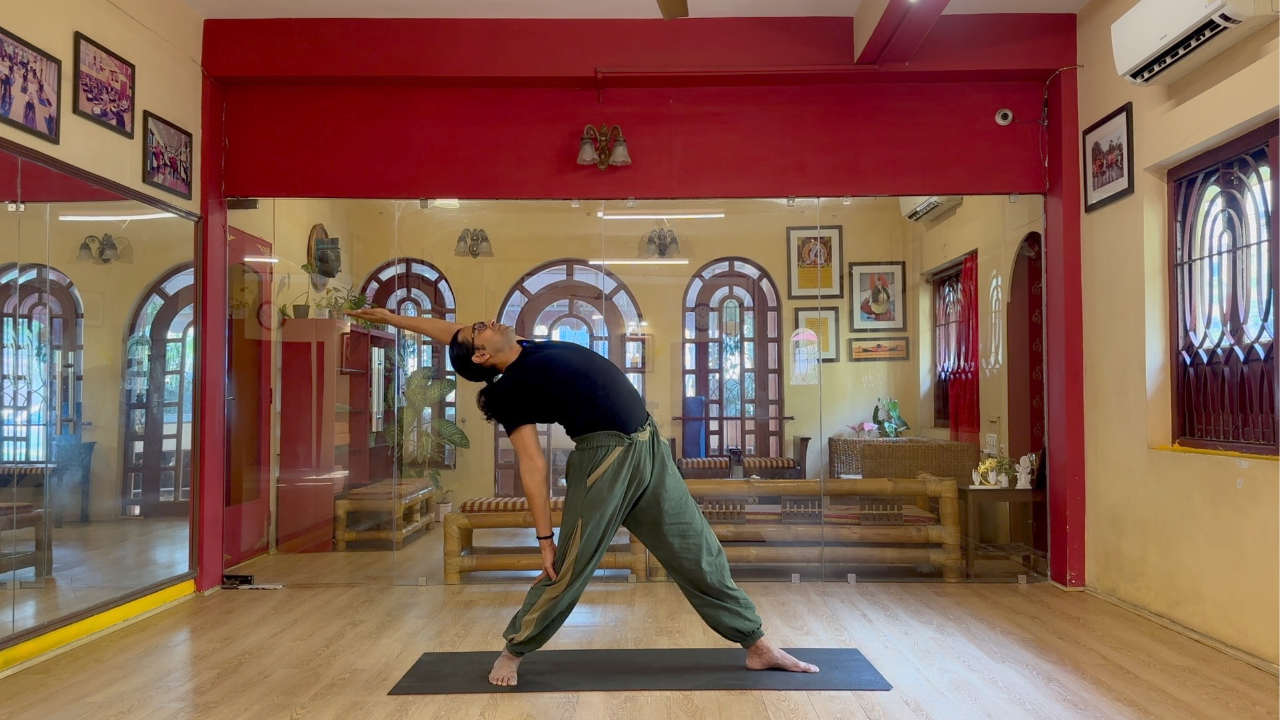
Chest openers and back bends. Modern life collapses us forward — the shoulders round in, the chest caves, the whole upper body contracts. Every time you reverse that and open the chest — whether it is bhujangasan, dhanurasan, setubandhasana, or even a simple standing chest opener — you are helping your heart. These postures improve circulation around the chest, stretch the pericardium and the muscles that surround the heart, and help you breathe more deeply.
Inversions. When you flip upside down — whether it is sarvangasan, shirshasana, or simply viparita karani (legs up the wall) — you reverse the flow of blood. The heart gets a different kind of stimulus. The venous return increases. And the baroreceptors in your neck and chest send a signal to the brain that the pressure is high — so the nervous system responds by slowing the heart rate down.
One important note here: if you already have high blood pressure, avoid shirshasana and even sarvangasan. The inversion increases the pressure in the head and the eyes. Viparita karani — legs against the wall — is a safer alternative that gives you many of the same benefits.
Surya namaskar is its own category. Done slowly, with breath synchronisation, it regulates. Done at a faster pace, with continuity, it builds capacity. It is one of the most complete cardiovascular tools in yoga.
Pranayama: The Most Underused Heart Medicine
Of everything I teach, pranayama — breath regulation — may have the most direct impact on the heart. And yet it is the thing people practice the least.
Let me explain why it works, so you are motivated to actually do it.
In your body, there are three oscillations happening simultaneously. Your breath rate. Your heart rate. And the oscillation of blood pressure. Normally, these three are not in sync. They are happening at their own frequencies.
When you do slow, regulated breathing — particularly anulom vilom, where you are breathing roughly five to six times per minute through alternating nostrils — something remarkable happens. These three oscillations come into synchrony. Your breath rate, heart rate, and blood pressure oscillation align. This creates a state of resonance that is deeply calming for the nervous system.
When the nervous system is calm, cortisol comes down. The fat stays quiet. IL-6 does not get released. CRP does not go up. The chain reaction we discussed earlier simply does not begin.
How to practice anulom vilom: Use your right thumb to close the right nostril. Inhale slowly and deeply through the left. Count how long that takes — say, six seconds. Now close the left nostril with your ring finger, release the thumb, and exhale through the right nostril for the same six seconds. Now inhale through the right for six counts. Switch and exhale through the left. That is one round. Do a minimum of 24 breaths — 12 from each side. If six seconds is easy, go to eight. The key is that your inhale and exhale are equal in duration.
Done consistently — even five to eight minutes a day — your cortisol levels will come down. Your internal environment will shift. You will feel it.
If anulom vilom is new to you, start even simpler: three-part breathing or box breathing first. These are the entry-level practices. Build from there.
Own Your Heart Health
I want to close with something I said to my students at the end of that session.
Heart health is not something to wait on. You do not wait for a diagnosis to start caring about your cardiovascular system. You understand how it works — the four components, the stress-inflammation pathway, the two things yoga does — and then you make a decision to act on that understanding.
Lifestyle changes have a huge impact on heart health. The quality of your blood — regulated through diet. The health of your arteries — built through movement and stress management. The capacity and regulation of the heart itself — built through consistent yoga practice and pranayama.
You do not need a gym. You do not need expensive equipment. You need a mat, your breath, and the willingness to show up every day.
Start with five minutes of anulom vilom tonight. Add a chest opener or a supported inversion tomorrow morning. Build from there.
Your heart has been working for you every single moment since before you were born. It is not asking for much in return.
Abhishek Maheshwari teaches yoga at Wellness Wisdom and Mystic Yoga. This post is based on a live session on Yoga for Heart Health. It is for educational purposes and not a substitute for medical advice. If you have a cardiac condition, please consult your doctor before beginning any new practice.
Want the full session? The lecture is on YouTube . The Heart Practitioner's Field Guide e-book drops Monday, April 27.